Goal setting has long been a practice that I have used in my creative and academic careers as well as my personal life—I have big goals, little goals and all sorts in between. I write them down, I revise them regularly and I break them down into actionable tasks, (Thanks to skills I learned in James Clear’s Atomic Habits). Alongside my goal-setting practice I use affirmations (every single day!) to work on my mindset—doing this has helped me immensely and allowed me to believe that I can reach the goals I’ve set for myself but also as motivation to do the work needed. A significant tactic that I have added to my goal-setting toolkit in the last 5 years or so is visualization. I started using it consciously (because I think it is something we do quite often unconsciously as we dream about the things we want or what we would like to achieve) near the end of my PhD journey as a last-ditch effort to pull myself through. I was desperate. I was heading into my 7th year, and I was physically and mentally exhausted, broke, and after my Viva (the equivalent to a defense in North America) where I received ”Revise and Resubmit” (which basically translates to “do or die) I had to make big shifts to just get it done. This is when I began adding visualization exercises to my meditation practice in an attempt to get enough momentum to supersede my crippling impostor syndrome and get myself across the finish line.
One of the main images I used in my visualization this time was of myself in my graduation regalia complete with the Tudor Bonnet (specifically worn by PhDs in the UK. But, not only would I visualize myself wearing it–I would focus on what it felt like to be wearing it—I would imagine my name being called at the graduation ceremony, I would imagine what shoes I was wearing as I walked across the stage–really leaning into all the sensations I could muster. Similarly, when I was interviewing for academic jobs I would visualize myself walking down the hallway of a university with a lanyard of keys in my hand as if I already had the jobs and I was rushing off to a meeting or class. I would see/feel myself walking with purpose and confidence (with a little bit of swagger)—I could hear my footsteps and the jingling of keys. I was using my imagination to put myself there.
This technique of course is nothing new, athletes have long used it–I’ve been watching the Olympics these past few weeks and loved watching the track athletes in particular as they are preparing for their events—you can see on their faces that they are visualizing their event—going through the paces in their mind and imagining their desired outcome. What I realized when I began integrating visualization into my goal setting was that it gave the goal clarity. It’s all well and good to want something but being absolutely clear about what that goal is – what it looks and feels like makes moving towards that goal much more real.
Studies have shown that we activate the same neural networks in our brains by simply visualizing ourselves doing something than we do by actually doing the thing. By creating clarity and detailed mental pictures I have found that both my focus on the goal as well as my motivation to do the work to reach the goal increase exponentially.
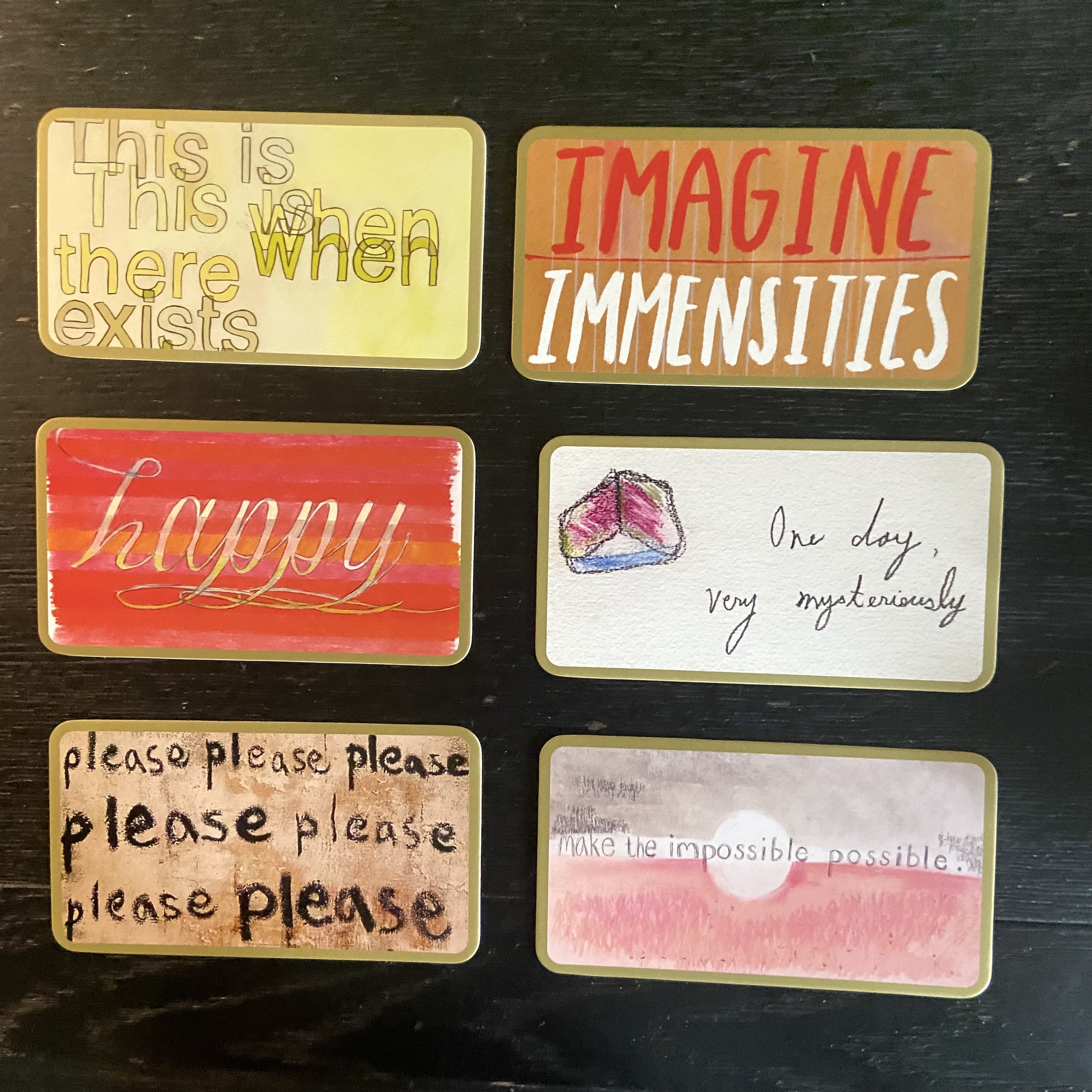
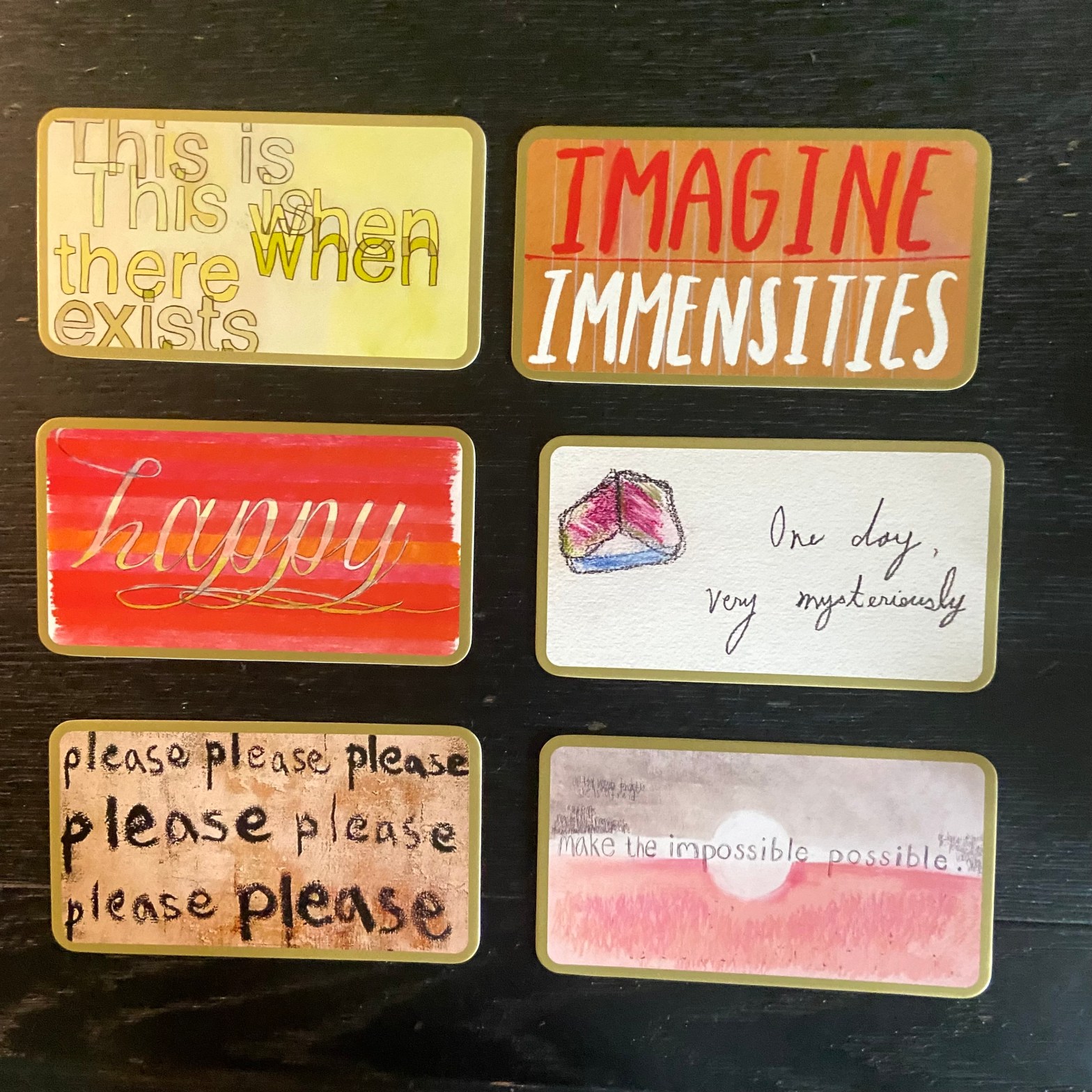
Enter Debbie Millman’s “The Remarkable Life Deck”. Described as “30 cards with generative prompts, an instructional booklet, and a workbook for creating your ten-year plan” I bought this months ago and never quite had the chance to commit to it until this past July. For an academic summer can be the perfect time to find some time and space to set (or revise) goals– so, with that in mind, I dove in and worked through the deck choosing one card a day for 30 days to meditate and write on
In an accompanying booklet, Millman (a massively influential designer, artist and educator) writes about how “The Remarkable Life Deck” came to be. She recounts how, during a summer intensive program being prompted by the legendary designer Milton Glaser to “envision the life that they could have if they pursued everything that they wanted, with certainty that they would succeed” by writing in detail about one day as their best and future self, an hour by hour account including everything they have ever dared to dream. Millman immersed herself in the exercise dreaming bigger than she had ever before and came away from the experience empowered and transformed. She recounts how she came across the essay one year later and was shocked to see some of the dreams had been accomplished, at four years in many more had manifested and more were in progress—by the 10-year mark a whopping 80 percent had materialized. She was sold on the power of visualization and began including this exercise in her teaching practice and naturally, as a designer this led to her creating the deck.
I’ve had a blast working through the cards—answering questions like “What are you telling yourself you can’t do that you can?” ”Describe your physical self” and “What does your home look like?”—They are thought-provoking and beautiful to look like – They have pushed me to see the big picture and expand my vision of what I truly desire the next 10 years to look like. I plan to come back to re-read my responses annually—checking in every July perhaps as I watch my remarkable life unfold.